People, places and names
- Start with Georgia. · Country
- Georgia is a country in the Caucasus, on the eastern shore of the Black Sea. The Meskhetian Turks’ historical homeland lies in its south. Country → historical homeland → city → today’s region.
- Meskheti is a historical region. · Historical homeland
- Meskheti is the historical and cultural name associated with the community’s homeland in southern Georgia. It is the source of the name “Meskhetian Turks”. It is not the name of a current administrative district.
- One city, two names. · City
- Akhaltsikhe is a city in that homeland. Ahıska is its traditional Turkish name, also used in the Ottoman period. The name lives on in “Ahıska Turks”. Akhaltsikhe also names the surrounding municipality. The community’s homeland includes many towns and villages, beyond this one city.
- Today: Samtskhe-Javakheti. · Modern administrative region
- Akhaltsikhe and its surrounding municipality are part of Samtskhe-Javakheti, one of Georgia’s present-day administrative regions. The outline shows today’s administrative region. It is not a boundary of historical Meskheti.
The Meskhetian Turks
The Meskhetian Turks, also known as Ahıska Turks, trace their homeland to Meskheti in southern Georgia. This documentary follows their history, forced displacement and life today.
Ahıska is the Turkish name for Akhaltsikhe, a city in that homeland. The community’s history extends across the surrounding towns and villages.
Before the borders, there was home.
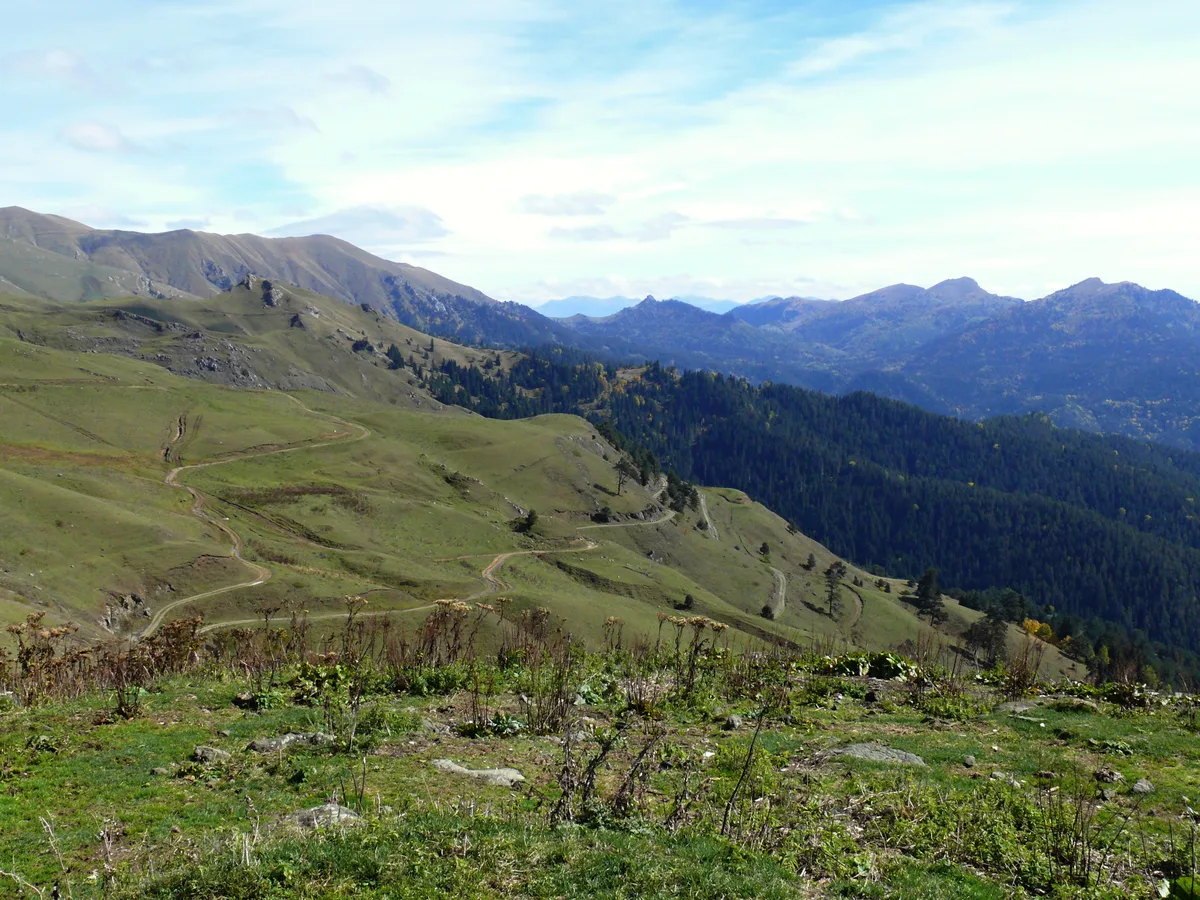
Around Akhaltsikhe — known in Turkish as Ahıska — villages, fields and mountain roads formed the world of generations of Turkish-speaking families. This was a lived landscape: work, neighbours, weddings, language and faith.
The region passed from Ottoman to Russian rule after the war of 1828–1829. Borders and authorities changed. Families built their lives in the historical region of Meskheti, in southern Georgia.
Today, Akhaltsikhe and its surrounding municipality are in the administrative region of Samtskhe-Javakheti. Meskheti remains a historical and cultural name; its extent should not be confused with today’s administrative boundaries.
Look at the people.
A family portrait holds more than names. The cut of a coat, an embroidered head covering, a belt and a sheathed dagger preserve details of place, occasion and social life.
Ahıska clothing was never one fixed uniform. It varied by village, age, means and occasion, and shared forms with neighbouring Caucasian cultures. Alongside formal çoha coats were everyday shirts, trousers, woollen clothes and the work of weaving and sewing.
A homeland, left behind.
The operation tore a community from its homeland. Families were loaded onto trains bound for the Soviet republics of Kazakhstan, Uzbekistan and Kyrgyzstan.
Many died during the journey and the first years of exile. Published totals differ: some archival figures group Ahıska Turks with Kurds and Hemshins deported from southern Georgia. The human loss cannot be reduced to one unqualified counter.
Thousands of kilometres. No choice of destination.
The main destinations were Kazakhstan, Uzbekistan and Kyrgyzstan. Distance was only part of the rupture: families arrived under a system that restricted where they could live, work and travel.
These lines connect the homeland to the destination republics. They are a visual guide to displacement, not a reconstruction of individual train routes.
A house could be rebuilt. Freedom could not.
In the special settlements, people worked, raised children and rebuilt households. Leaving a settlement required permission from the local commandant; registration and surveillance shaped ordinary life.
The restrictions were lifted in 1956. A general right to return to Ahıska did not follow. Petitions, collective organising and attempts to go home continued for decades.
For many families, exile happened twice.
Families fled or were evacuated from the valley. The Council of Europe later reported that more than 70,000 left Uzbekistan and were scattered across seven Soviet republics.
When the Soviet Union dissolved, new borders brought new questions of citizenship, residence and rights. In Russia's Krasnodar region, many Ahıska Turks faced exclusion; a US refugee resettlement programme began in 2004.
Can a place remain home from far away?
Georgia's 1999 accession to the Council of Europe included commitments on repatriation. A law followed in 2007. Legal recognition, however, did not automatically become a journey home.
In 2024, Council of Europe monitors still described limited actual return and barriers to citizenship. Today's community contains many relationships to the homeland — the wish to return, the work of remembrance, and lives rooted elsewhere.
Many countries. A connected people.
Large communities live in Central Asia, Türkiye, Russia and Azerbaijan, with others in the United States, Georgia, Ukraine and beyond.
These estimates describe a moment in January 2022. They cannot capture every person or every later journey. National censuses often use broader ethnic categories, making a precise Ahıska count difficult.
Meet the atlas's creator, Djani Efendi.
A people is more than its displacement.
Ahıska culture lives through people: in family and community relationships, language, food, celebrations, music and memory. Traditions travel, adapt and acquire new meanings.
The story continues wherever people keep those connections alive. This atlas is a beginning: a way to see a shared history, and to make room for the many lives within it.